Estimated Reading Time: 7 Minutes
Cadillac’s historic F1 entry and the woman shaping its first impression
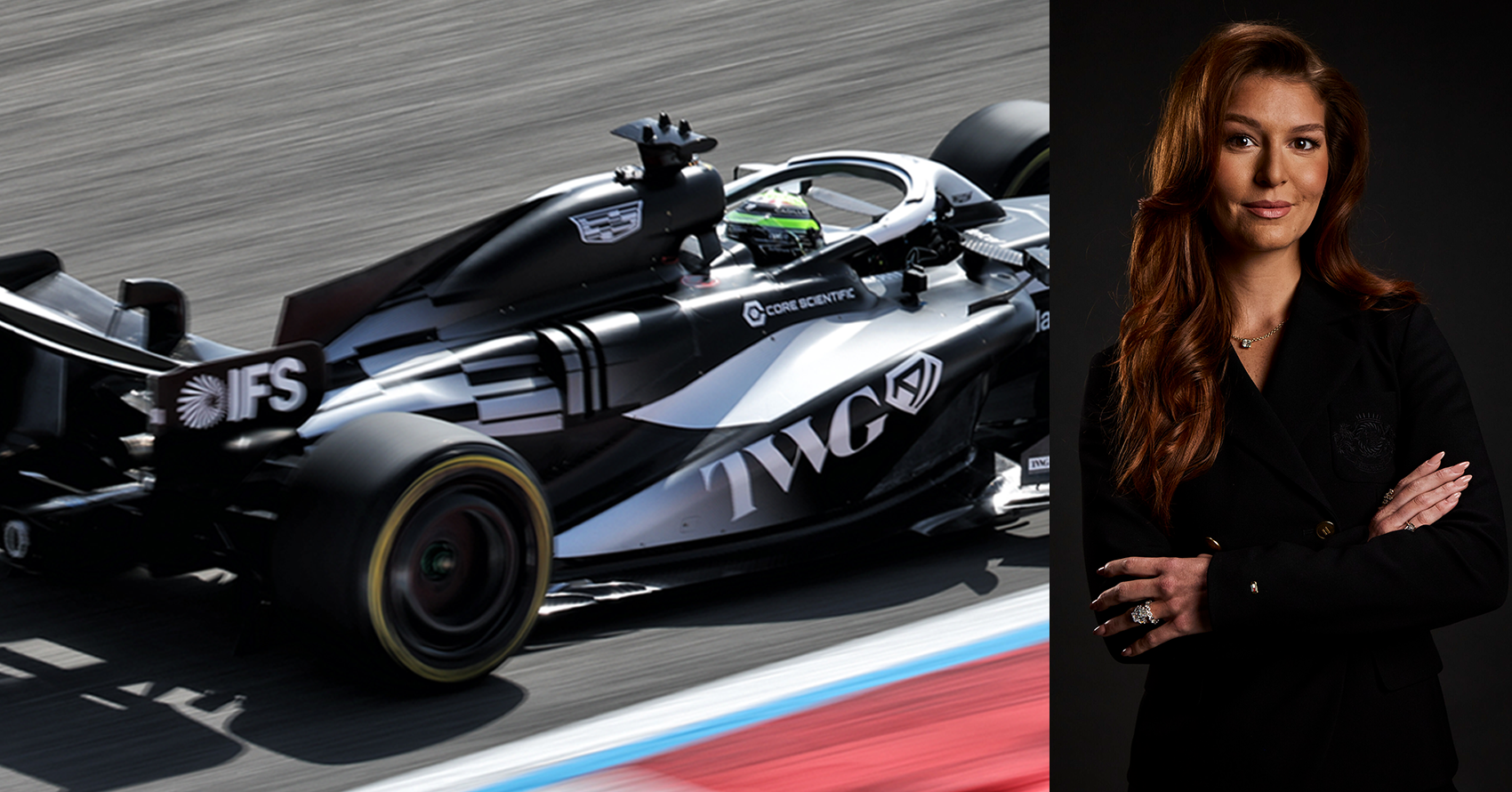
Courtesy of the Cadillac Formula 1 Team
February 10, 2026
Cadillac is the first American-owned team in modern history to enter Formula 1, ending a half-century drought. Behind this milestone moment is Cassidy Towriss, and for her designing an F1 car isn’t just about aesthetics; it’s a strategic catalyst for how a new American team introduces itself to the world.
Towriss is shaping a livery and helping to define what an American presence in Formula 1 looks and feels like in a global arena long dominated by European sensibilities. We spoke with her to talk about pride, pressure, Detroit, design, and what it takes to build something that lasts.
The Female Quotient: Cadillac is the first American-owned team in modern history to enter F1. As someone at the heart of this journey, how does it feel to be a driving force behind this new era of American racing?
Cassidy Towriss: It’s surreal, honestly. Formula 1 has felt like this global stage that America watched from the outside, so helping bring an American-owned team into that world feels incredibly meaningful. There’s pride in it, but also a responsibility; not just to show up, but to earn our space.
It’s humbling too. Part of me still feels like the kid who just loved racing, so having a voice in shaping something of this scale can feel unreal. This isn’t just a headline or a business milestone. It’s years of belief, risk, and creative vision coming together through a collective effort.This is just the beginning, and it’s the kind of beginning you work your whole life to be ready for.
FQ: You’ve said, “Fashion isn’t superficial; it’s strategic and powerful.” How did you translate that philosophy into the 2026 livery?
CT: Fashion communicates before anything else does: before performance, before results, before people even hear you speak. That’s why I’ve never seen it as superficial. It signals identity, intent, and confidence. And for a new team entering Formula 1, that first signal matters.
With the 2026 livery, every choice was intentional. The black and white palette isn’t just aesthetic. Black reflects our attitude, a relentless determination that defines how we work. It’s the edge, the conviction, the refusal to approach this quietly. The white is aspirational. It represents what we’re building toward and the clarity guiding us forward.
Fashion also teaches restraint. What you leave out can be just as powerful as what you include. The livery needed to feel elevated but grounded, American without being cliché, premium without feeling distant.
Ultimately, it’s about emotional connection. If the car feels elevated and authentic, people respond, even if they can’t immediately explain why. That’s the power of fashion and a first impression. And that’s what we wanted to bring into Formula 1.
FQ: F1 is often dominated by European design sensibilities. What were the distinctly American cues you wanted to ensure were present in Cadillac’s F1 identity?
CT: We were very intentional about defining “distinctly American” without relying on obvious symbols. Cadillac is an American icon. Tommy Hilfiger is an American icon. Jim Beam is an iconic American brand. Part of expressing that identity started with who we chose to stand beside.
Those partnerships bring authenticity and heritage that speak for themselves. Working with Tommy allowed us to introduce red, white, and blue in a refined, modern way, without making it literal or expected. There’s a quiet confidence in that approach. The goal was authenticity. When identity is real, it doesn’t need to be performative.
FQ: If the 2026 car had a “soul” tied to Detroit, what feeling would it embody?
CT: It reflects Detroit’s forward momentum; the constant drive toward innovation, performance, and what comes next.
That mindset is deeply aligned with Cadillac and General Motors. It’s about progress. The car represents the people behind it: teams who care deeply about craft, precision, and getting better every day. If there’s a piece of Detroit in it, it’s the relentless focus on building forward.
FQ: How does your creative leadership challenge the status quo in a male-dominated sport and set a new standard for women in executive motorsport roles?
CT: I don’t wake up thinking about challenging the status quo. I wake up thinking about doing the work well and bringing a perspective that hasn’t always been present.
Motorsport has traditionally been shaped through a very specific lens. What I bring naturally widens that lens. I approach decisions through brand, culture, emotion, and audience connection, alongside performance and engineering. Because this sport is also about entertainment.
Understanding what makes people feel something, what draws them in and what makes them stay, matters. I care deeply about people as much as I care about the sport, and that combination gives me an instinct for what will resonate.
For women in this space, I hope it expands what feels possible. If this moment helps define a new standard, I hope it says that women can shape this sport not by adapting to it, but by adding to it.
FQ: What advice would you give to young girls who dream of being part of F1, whether as a driver, engineer, or leader?
CT: Find a way in, any way in, and start learning the sport from the inside as early as possible.
Motorsport is incredibly competitive and surprisingly small. Experience matters. The sooner you’re in it, the sooner you understand how teams operate, how decisions get made, and where your skills truly fit.
I’m very aware that my path isn’t the hardest barrier to break. Brand, marketing, and communications roles are often where women are welcomed first, and that progress matters. But the biggest breakthroughs are still happening in technical roles, engineering, and on the driving side.
So be strategic. Learn skills that teams genuinely need, whether that’s engineering, data, aerodynamics, strategy, operations, marketing or design. Be willing to start in roles that aren’t glamorous. Pay attention to how trust and credibility are built, because that matters deeply. And once you’re in, stay curious and keep raising your standard.
This sport doesn’t hand out opportunities easily. But if you’re serious and willing to put in the work to understand it, you can build a path, one step, one role, one relationship at a time.
FQ: If you tell your younger self one thing, what would it be?
CT: I would tell her, “It gets better.”
Being young is harder than people admit. There are so many unknowns, and even though everyone else is figuring it out too, it can still feel lonely. But it does ease up.
I’d also tell her to worry less about what people think. Not every opinion deserves equal weight. Being a good person, trying your best, making mistakes, and learning as you go is enough. You don’t have to have everything figured out. You just have to keep growing into yourself.
FQ: Where have you caused some “good trouble” in your career?
CT: Honestly? Probably by saying the thing people are thinking but not saying.
Not in a bulldozing way but as I’ve grown more confident, I’ve become less willing to nod along when something feels off. During the push to get an F1 entry, I was often the loudest voice behind the scenes, pushing, questioning, and refusing to let the momentum fade. I was told to calm down more than once.
For me, good trouble is rooted in care. When I believe in something, the sport, the team, the people, I’ll push for it. Because persistence and honesty are what keep things moving forward.